
Is your Retirement Plan Realistic?

Is your Retirement Plan Realistic

Have you been planning your retirement? Did you know those that work with a financial planner have 445% bigger nest eggs by the time they retire? Who wouldn’t want 445% more in savings to use for travelling, on loved ones, or medical expenses?

Phase One: Save, Save, Save

The best thing you can do is start saving. A household income of $56,000 could have around $900,000 if they consistently invest 15% of their income over a 25-year period. If they had 30 years to invest, they’d have over 1.5 million! The important thing to remember is to pay for your ongoing financial obligations now as you continue to put more money aside.

Phase Two: Look into the Details

An investing advisor can run projections based on your monthly contributions and expected retirement age. This will give you an idea of what inflation, taxes, and/or fees may apply down the road as you continue to invest in your retirement.

Phase Three: Being Realistic

Once your big expenses are taken care of, your children are out of the house, your house may be paid for, you can really focus on putting more funds to your retirement account. Keep in mind as you age, once you reach 60 years old, you’ll want to purchase long-term care (LTC) insurance to protect your investment funds. 

There are some big mistakes you will want to avoid as you plan your retirement. Make sure you do not rely too heavily on social security. As presidential administrations change, and generations continue to have new priorities, the future of social security is uncertain. Most seniors need 80% of their former income to live comfortably. Social security does not come close to being 80% of most people’s earned income for a month. Not to mention, there are additional costs in getting older—medical bills, travel to see loved ones, etc. Therefore, it is important to remember that you will need to put money side. 

Tax Planning for Retirement

If you are leaving your job, you have to be 55 years or older to tap into your 401(k) without incurring penalty fees. You will, however still owe money in taxes on your withdrawals. If you roll the money over to an IRA, you must be 59 ½ years old to avoid early withdrawal penalties when taking money out of the account. 

There is some confusion about how withdrawals from Roth IRAs are taxed. The IRS believes that the first money withdrawn comes from your annual contributions and can be accessed tax free and penalty free at any time. You will be charged a penalty, however, if you are under 59 ½ years old and the account has not been open for at least 5 years. 

You should also be careful avoiding taking too many withdrawals that can bump you into a higher income bracket. This is often forgotten by 401(k) holders as they continue to take withdraws from their retirement accounts. 

For more advise on retirement funds, taxation, and planning your future, contact us today to get your consultation started. We are here to provide you excellent service and the most knowledge for you to make an educated decision about your retirement. 

How Zagmout & Company CPAs Can Help

Zagmout & Company CPAs helps individuals coordinate retirement income, tax planning, required distributions, investment accounts, and long-term financial decisions.

SCHEDULE YOUR FREE CONSULTATION

Disclaimer: This article is for general informational purposes only and does not constitute accounting, tax, legal, financial, or investment advice. The application of these matters depends on individual circumstances and should be evaluated with qualified professional advisers.

The right way to prioritize tax-preferenced savings strategies

The right way to prioritize tax-preferenced savings strategies

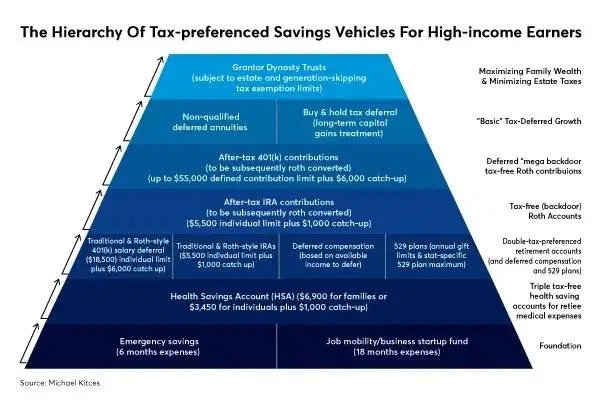
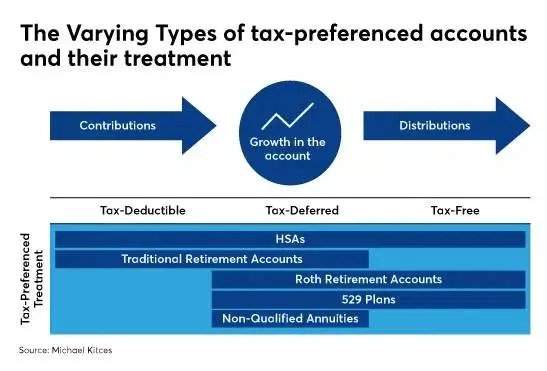
The federal government has long incentivized saving by offering some combination of three tax preference types: deductibility, deferral and tax-free distributions. Yet for more affluent households, it’s a question of dialing in an optimal mix of tax-preferenced vehicles. To do that, a hierarchy is in order.

An optimal approach feeds the best preferenced accounts first, and as contribution limits are met, spills additional savings over to the next tier. When used in a holistic planning strategy, this hierarchical model can help high-income earners limit their tax liabilities and maximize growth.

At their core, tax-preferenced retirement accounts fit two archetypes: traditional accounts, which provide a tax deduction for contributions but ultimately tax the distributions; and Roth-style accounts, which are not deductible when contributions are made but are tax-free when distributed.

These retirement accounts are effectively double-tax-preferenced, in that they receive both tax-deferred status on assets in the account, plus either a deduction upfront or tax-free distribution treatment at the end.

Notably though, some tax-preferenced savings accounts are even better. HSAs are triple-tax-free accounts, providing tax-deductible contributions upfront, tax-deferred growth and tax-free distributions for qualified expenses. By contrast, a non-qualified annuity only offers one tier: tax-deferral, as contributions are not tax-deductible, nor are distributions tax-free.

Vehicle preference is simply based on whatever goals an individual is pursuing — whether it’s paying for medical expenses and health insurance deductibles, sending kids to college or saving for retirement. To the extent that dollars are limited, this is an exercise in building up an initial emergency reserve, then allocating scarce resources to whatever goals have the greatest priority, while hoping to make the rest up with future savings — and future income increases— down the road.

Households that might be earning $300,000 or more, however, tend to apply a different lens on these goals — whether it’s saving for retirement, building family wealth, paying for college or maximizing the economic value of the dollars being saved. The question for them is not whether a certain type of account can or will be used, but rather how it should be used in the holistic mix of things.

TIER 1: HSAs

The first and best place to commit to long-term tax-preferenced savings for high-income individuals is an HSA. The key to maximizing the HSA as a high-income savings account is to pay all actual medical expenses out of pocket, while also contributing to the HSA to cover future medical expenses. Treated in such a way, the HSA effectively becomes a supplemental retirement savings account earmarked to provide tax-free distributions for any deductible medical expenses described under IRC Section 213.

These include most long-term care expenses, co-pays and deductibles under Medicare in retirement, plus long-term care insurance premiums up to the age-based LTC premium limits and even Medicare Part B and Part D premiums — though not Medigap supplemental insurance premiums.

Of course, the caveat to having an HSA is that it’s only permitted for those who have a high-deductible health plan in the first place, with minimum deductibles of $1,350 for individuals and $2,700 for families, and maximum out-of-pocket costs as high as $6,650 for individuals and $13,300 for families. On the other hand, arguably most high-income households should have a high-deductible plan simply because they have the financial wherewithal to self-insure a larger deductible and have the cash flow available to cover the cost — on top of making their HSA contribution.

TIER 2: RETIREMENT

After the triple-tax-free HSA, the next tier consists of various double-tax-preferenced retirement accounts. High-income individuals tend to feel the pressure and impact of the top tax brackets, and as such typically prefer Roth-style accounts, which eliminate that tax bite on growth.

Ironically though, for most high-income individuals it’s actually better to contribute to a traditional account rather than a Roth, in order to get the upfront tax deduction at those current top tax rates. Indeed, a Roth retirement account only wins relative to a traditional account if the tax rates at the time of distribution are higher — or at least equal to — the tax rates at the time of contribution.

For those who are already in the top tax bracket, it’s difficult to achieve higher future tax rates. Even very affluent married couples have trouble reaching the $600,000 annual ordinary income level that would place them there. And despite fears of rising future tax rates given current budget deficits, the trend in Washington is toward actually lowering the top tax bracket — albeit while also trimming deductions.

Consequently, the Roth-style account really only suits those who are not just in the top tax bracket now, but will be there for life. These are households with $15 million-plus levels of net worth. For the rest, it’s better to get the tax deduction now, at top rates. Those who want a tax-free Roth in the long run should do partial Roth conversions later, i.e., after the wage/employment income ends and the tax bracket drops.

In practice, this means not contributing to a backdoor Roth IRA or Roth 401(k), and saving instead the $5,500 maximum (or $6,500 for those over age 50) into traditional pre-tax IRAs if possible. Very high-income individuals can only do so if neither they nor their spouse is already an active participant in an employer retirement plan, and are otherwise maximizing contributions up to the $18,500 limit — or $24,500 with catch-up contributions for those over age 50 — to a pre-tax 401(k) plan.

For high-income individuals who either own businesses or at least are sole proprietors filing a Schedule C, there are even more savings opportunities. Total contributions to a 401(k)-salary-deferral-plus-profit-sharing plan in the aggregate can be as high as $55,000. This effectively allows as much as another $36,500 in contributions above the $18,500 401(k) limit alone for those earning at least $270,000/year, in addition to another $6,000 in catch-up contributions. Even higher contributions may be feasible for those in their 50s or 60s who want to set up a supplemental defined benefit plan.

Notably however, business owners with employees must make contributions to other employees as well, which may reduce the value of making additional profit-sharing or defined benefit plan contributions, causing alternatives like a deferred compensation plan to look more appealing.

It’s also worth leveraging 529 college savings plans at this tier to maximize the opportunity for tax-free growth, especially for younger children who have a decade or more to benefit from tax-deferred compounding. In fact, for those who anticipate more than enough wealth to cover the family’s needs, additional funding into a 529 plan — up to the plan’s limits — is compelling, as the beneficiary can always be changed to other family members down the line.

TIER 3: TAX-FREE ROTHS

As noted earlier, most high-income individuals should maximize pre-tax retirement accounts first — and at best, only contribute to Roth-style accounts later via a partial Roth conversion. The caveat is that high-income individuals who aren’t business owners will be capped at $18,500 of annual 401(k) contributions barring catch-ups, and at that point may not be able to make a pre-tax contribution to a traditional retirement account at all.

In such situations, making an after-tax contribution to a non-deductible IRA is still viable, and helps avoid the 3.8% Medicare surtax on investment growth. As for high-income individuals, direct Roth contributions are not feasible due to the Roth income limits.

There are no such limits to backdoor Roth contributions, but it is still important to navigate around the IRA aggregation rule that can cause non-deductible IRA contributions to become partially taxable — unless the other dollars are first rolled into a separate 401(k) plan — and wait a reasonable time period (e.g., 12 months) between the non-deductible IRA contribution and subsequent conversion to avoid the step transaction doctrine. Single-earner-high-income couples should also bear in mind that a non-working spouse can make non-deductible IRA contributions that are subsequently converted to a Roth under the Spousal IRA rules.

TIER 4: GOING MEGA

The next option is a deferred Roth contribution, also sometimes called the mega-backdoor Roth.

Popularized after IRS Notice 2014-54 explicitly permitted it, the mega-backdoor Roth makes after-tax contributions to a 401(k) plan — above and beyond the traditional salary deferral that can be done pre-tax — that are later converted to a Roth once the money can be rolled out of the plan either at retirement or as an in-service distribution where permitted.

As the name implies, the contribution limits are significantly higher — starting above the $18,500 pre-tax salary deferral limit and extending all the way up to the $55,000 contribution limit for total dollars into any defined contribution plan, for a potential maximum mega-backdoor Roth contribution as high as $36,500.

However, several caveats reduce its appeal relative to the preceding tiers.

The biggest: While IRS Notice 2014-54 permitted after-tax contributions to be converted to a Roth account, the tax-free status doesn’t begin until the dollars are converted to a Roth. This means they need to leave the employer retirement plan.

Consequently, the mega-backdoor Roth is often considered a deferred Roth contribution, a distinction that isn’t earned until either the employee retires or at least separates from service — unless the plan allows in-service distributions.

In addition, the $55,000 limit for all contributions includes both the $18,500 salary deferral limit, after-tax contributions and profit-sharing or other employer pre-tax contributions. Employers that make profit-sharing or salary-matching contributions reduce the remaining availability of making after-tax contributions.

There is also at least some risk that Congress will eliminate the ability to convert after-tax dollars. Such a regulation has already been proposed once. Nonetheless, the worst case scenario is that the after-tax contributions will grow tax-deferred, similar to other non-deductible contributions further down the hierarchy.

TIER 5: BASIC GROWTH

These high-income savings vehicles don’t provide any upfront tax deduction or tax-free distributions, but do allow for tax-deferred growth.

The most common vehicle at this tier is the non-qualified deferred annuity, which when held outside a retirement account provides tax-deferred growth. That said, as an annuity there is an additional cost for the annuity guarantees and the tax deferral wrapper.

The good news is that for high-income individuals who just want tax deferral, there are a growing number of Investment-Only Variable Annuity, or IOVA, contracts that have few guarantees, which gives them a very low cost — sometimes just 0.50%/year or even lower — and makes it worthwhile to pay them just for the tax-deferral treatment.

Classically, permanent cash value life insurance has also been used as a tax deferral vehicle, absorbing the costs of life insurance death benefits to access the tax-deferred growth treatment available, where the growth is subsequently borrowed against to avoid triggering tax consequences on distribution.

Yet it’s impossible to borrow and use all the cash value, lest the policy lapse and cause a substantial tax consequence. Furthermore, in today’s environment annuities are often inexpensive enough that the insurance may not represent a pure tax-deferral strategy. At best it must be carefully designed to allow a maximal internal rate of return.

As a result, cash value life insurance is more commonly used for at least those who have a blended need for savings and a death benefit, for ultra-high-net-worth investors who can access lower-cost private placement life insurance policies — albeit with a higher upfront cost that keeps them impractical for most — or simply those wanting to maximize the tax-free death benefit of the life insurance and don’t actually care about using the cash value.

The good old-fashioned taxable brokerage account can also be a tax-deferred growth vehicle, at least for long-term growth assets — because capital gains aren’t taxable until holdings are sold. In fact, a zero-dividend growth stock held until liquidation gets the same tax-deferral treatment as an annuity, but without the cost of the annuity wrapper.

Unfortunately, investments with a non-trivial dividend and even a modest level of ongoing turnover can experience enough tax drag to make them less appealing. Nonetheless, for buy-and-hold investors of long-term growth stocks — or certain tax-managed mutual funds or even real estate — sometimes it’s not actually necessary to find an alternative, as capital gains themselves are tax-deferred as long as there’s a plan for how to unwind them.

TIER 6: DYNASTY TRUSTS

For those who want to further maximize tax-preferenced growth with additional savings, there’s the grantor dynasty trust.

These are not necessarily income tax savings vehicles. In fact, trusts face a top tax bracket of 37% at just $12,500 of taxable income, making such compressed trust tax rates worse — or at best, no better — than what high-income households already face.

Instead, the tax savings appeal of a dynasty trust comes in structuring it as a grantor trust, which makes the income tax consequences remain at the levels of the original grantor, even after the dollars have been gifted/transferred into the trust. This means the grantor is unmoved — paying taxes on any growth in the trust that would have been paid by just keeping the money and investing it.

This approach allows the grantor to use dollars in their estate to pay the income tax bill for a trust that is growing outside of his/her estate — permissible under Revenue Ruling 2004-64. So while the grantor ends up in the same position, the dynasty trust effectively grows income-tax-free because it’s paid by the grantor, and estate-tax-free since it’s a dynasty trust.

CAREER CONSIDERATIONS

Notwithstanding these six tiers, having a healthy emergency fund and disability insurance are paramount.

Income can drop unexpectedly even for high earners, and being compelled to liquidate tax-preferenced accounts can leave a household worse off than having just skipped tax-preferenced accounts altogether. That’s not to mention the growing base of research that shows having reasonable cash on hand increases our happiness.

And the ideal may not just be the classic six-month emergency fund, but an additional 18 months to allow for job mobility and business/career opportunities. There’s nothing more freeing about making good career decisions than knowing you can take risks and still have an ample cushion to fall back on.

The greatest wealth creation opportunity for those who are still working is the chance of finding a job or starting a business that creates even better earnings. Put another way, the best tax-deferred savings strategy may just be you investing in your own human capital.

Vehicle preference is simply based on whatever goals an individual is pursuing — whether it’s paying for medical expenses and health insurance deductibles, sending kids to college or saving for retirement. To the extent that dollars are limited, this is an exercise in building up an initial emergency reserve, then allocating scarce resources to whatever goals have the greatest priority, while hoping to make the rest up with future savings — and future income increases — down the road.

Households that might be earning $300,000 or more, however, tend to apply a different lens on these goals — whether it’s saving for retirement, building family wealth, paying for college or maximizing the economic value of the dollars being saved. The question for them is not whether a certain type of account can or will be used, but rather how it should be used in the holistic mix of things.

TIER 1: HSAs

The first and best place to commit to long-term tax-preferenced savings for high-income individuals is an HSA. The key to maximizing the HSA as a high-income savings account is to pay all actual medical expenses out of pocket, while also contributing to the HSA to cover future medical expenses. Treated in such a way, the HSA effectively becomes a supplemental retirement savings account earmarked to provide tax-free distributions for any deductible medical expenses described under IRC Section 213.

These include most long-term care expenses, co-pays and deductibles under Medicare in retirement, plus long-term care insurance premiums up to the age-based LTC premium limits and even Medicare Part B and Part D premiums — though not Medigap supplemental insurance premiums.

Of course, the caveat to having an HSA is that it’s only permitted for those who have a high-deductible health plan in the first place, with minimum deductibles of $1,350 for individuals and $2,700 for families, and maximum out-of-pocket costs as high as $6,650 for individuals and $13,300 for families. On the other hand, arguably most high-income households should have a high-deductible plan simply because they have the financial wherewithal to self-insure a larger deductible and have the cash flow available to cover the cost — on top of making their HSA contribution.

TIER 2: RETIREMENT

After the triple-tax-free HSA, the next tier consists of various double-tax-preferenced retirement accounts. High-income individuals tend to feel the pressure and impact of the top tax brackets, and as such typically prefer Roth-style accounts, which eliminate that tax bite on growth.

Ironically though, for most high-income individuals it’s actually better to contribute to a traditional account rather than a Roth, in order to get the upfront tax deduction at those current top tax rates. Indeed, a Roth retirement account only wins relative to a traditional account if the tax rates at the time of distribution are higher — or at least equal to — the tax rates at the time of contribution.

For those who are already in the top tax bracket, it’s difficult to achieve higher future tax rates. Even very affluent married couples have trouble reaching the $600,000 annual ordinary income level that would place them there. And despite fears of rising future tax rates given current budget deficits, the trend in Washington is toward actually lowering the top tax bracket — albeit while also trimming deductions.

Consequently, the Roth-style account really only suits those who are not just in the top tax bracket now, but will be there for life. These are households with $15 million-plus levels of net worth. For the rest, it’s better to get the tax deduction now, at top rates. Those who want a tax-free Roth in the long run should do partial Roth conversions later, i.e., after the wage/employment income ends and the tax bracket drops.

In practice, this means not contributing to a backdoor Roth IRA or Roth 401(k), and saving instead the $5,500 maximum (or $6,500 for those over age 50) into traditional pre-tax IRAs if possible. Very high-income individuals can only do so if neither they nor their spouse is already an active participant in an employer retirement plan, and are otherwise maximizing contributions up to the $18,500 limit — or $24,500 with catch-up contributions for those over age 50 — to a pre-tax 401(k) plan.

For high-income individuals who either own businesses or at least are sole proprietors filing a Schedule C, there are even more savings opportunities. Total contributions to a 401(k)-salary-deferral-plus-profit-sharing plan in the aggregate can be as high as $55,000. This effectively allows as much as another $36,500 in contributions above the $18,500 401(k) limit alone for those earning at least $270,000/year, in addition to another $6,000 in catch-up contributions. Even higher contributions may be feasible for those in their 50s or 60s who want to set up a supplemental defined benefit plan.

Notably however, business owners with employees must make contributions to other employees as well, which may reduce the value of making additional profit-sharing or defined benefit plan contributions, causing alternatives like a deferred compensation plan to look more appealing.

It’s also worth leveraging 529 college savings plans at this tier to maximize the opportunity for tax-free growth, especially for younger children who have a decade or more to benefit from tax-deferred compounding. In fact, for those who anticipate more than enough wealth to cover the family’s needs, additional funding into a 529 plan — up to the plan’s limits — is compelling, as the beneficiary can always be changed to other family members down the line.

TIER 3: TAX-FREE ROTHS

As noted earlier, most high-income individuals should maximize pre-tax retirement accounts first — and at best, only contribute to Roth-style accounts later via a partial Roth conversion. The caveat is that high-income individuals who aren’t business owners will be capped at $18,500 of annual 401(k) contributions barring catch-ups, and at that point may not be able to make a pre-tax contribution to a traditional retirement account at all.

In such situations, making an after-tax contribution to a non-deductible IRA is still viable, and helps avoid the 3.8% Medicare surtax on investment growth. As for high-income individuals, direct Roth contributions are not feasible due to the Roth income limits.

There are no such limits to backdoor Roth contributions, but it is still important to navigate around the IRA aggregation rule that can cause non-deductible IRA contributions to become partially taxable — unless the other dollars are first rolled into a separate 401(k) plan — and wait a reasonable time period (e.g., 12 months) between the non-deductible IRA contribution and subsequent conversion to avoid the step transaction doctrine. Single-earner-high-income couples should also bear in mind that a non-working spouse can make non-deductible IRA contributions that are subsequently converted to a Roth under the Spousal IRA rules.

TIER 4: GOING MEGA

The next option is a deferred Roth contribution, also sometimes called the mega-backdoor Roth.

Popularized after IRS Notice 2014-54 explicitly permitted it, the mega-backdoor Roth makes after-tax contributions to a 401(k) plan — above and beyond the traditional salary deferral that can be done pre-tax — that are later converted to a Roth once the money can be rolled out of the plan either at retirement or as an in-service distribution where permitted.

As the name implies, the contribution limits are significantly higher — starting above the $18,500 pre-tax salary deferral limit and extending all the way up to the $55,000 contribution limit for total dollars into any defined contribution plan, for a potential maximum mega-backdoor Roth contribution as high as $36,500.

However, several caveats reduce its appeal relative to the preceding tiers.

The biggest: While IRS Notice 2014-54 permitted after-tax contributions to be converted to a Roth account, the tax-free status doesn’t begin until the dollars are converted to a Roth. This means they need to leave the employer retirement plan.

Consequently, the mega-backdoor Roth is often considered a deferred Roth contribution, a distinction that isn’t earned until either the employee retires or at least separates from service — unless the plan allows in-service distributions.

In addition, the $55,000 limit for all contributions includes both the $18,500 salary deferral limit, after-tax contributions and profit-sharing or other employer pre-tax contributions. Employers that make profit-sharing or salary-matching contributions reduce the remaining availability of making after-tax contributions.

There is also at least some risk that Congress will eliminate the ability to convert after-tax dollars. Such a regulation has already been proposed once. Nonetheless, the worst case scenario is that the after-tax contributions will grow tax-deferred, similar to other non-deductible contributions further down the hierarchy.

TIER 5: BASIC GROWTH

These high-income savings vehicles don’t provide any upfront tax deduction or tax-free distributions, but do allow for tax-deferred growth.

The most common vehicle at this tier is the non-qualified deferred annuity, which when held outside a retirement account provides tax-deferred growth. That said, as an annuity there is an additional cost for the annuity guarantees and the tax deferral wrapper.

The good news is that for high-income individuals who just want tax deferral, there are a growing number of Investment-Only Variable Annuity, or IOVA, contracts that have few guarantees, which gives them a very low cost — sometimes just 0.50%/year or even lower — and makes it worthwhile to pay them just for the tax-deferral treatment.

Classically, permanent cash value life insurance has also been used as a tax deferral vehicle, absorbing the costs of life insurance death benefits to access the tax-deferred growth treatment available, where the growth is subsequently borrowed against to avoid triggering tax consequences on distribution.

Yet it’s impossible to borrow and use all the cash value, lest the policy lapse and cause a substantial tax consequence. Furthermore, in today’s environment annuities are often inexpensive enough that the insurance may not represent a pure tax-deferral strategy. At best it must be carefully designed to allow a maximal internal rate of return.

As a result, cash value life insurance is more commonly used for at least those who have a blended need for savings and a death benefit, for ultra-high-net-worth investors who can access lower-cost private placement life insurance policies — albeit with a higher upfront cost that keeps them impractical for most — or simply those wanting to maximize the tax-free death benefit of the life insurance and don’t actually care about using the cash value.

The good old-fashioned taxable brokerage account can also be a tax-deferred growth vehicle, at least for long-term growth assets — because capital gains aren’t taxable until holdings are sold. In fact, a zero-dividend growth stock held until liquidation gets the same tax-deferral treatment as an annuity, but without the cost of the annuity wrapper.

Unfortunately, investments with a non-trivial dividend and even a modest level of ongoing turnover can experience enough tax drag to make them less appealing. Nonetheless, for buy-and-hold investors of long-term growth stocks — or certain tax-managed mutual funds or even real estate — sometimes it’s not actually necessary to find an alternative, as capital gains themselves are tax-deferred as long as there’s a plan for how to unwind them.

TIER 6: DYNASTY TRUSTS

For those who want to further maximize tax-preferenced growth with additional savings, there’s the grantor dynasty trust.

These are not necessarily income tax savings vehicles. In fact, trusts face a top tax bracket of 37% at just $12,500 of taxable income, making such compressed trust tax rates worse — or at best, no better — than what high-income households already face.

Instead, the tax savings appeal of a dynasty trust comes in structuring it as a grantor trust, which makes the income tax consequences remain at the levels of the original grantor, even after the dollars have been gifted/transferred into the trust. This means the grantor is unmoved — paying taxes on any growth in the trust that would have been paid by just keeping the money and investing it.

This approach allows the grantor to use dollars in their estate to pay the income tax bill for a trust that is growing outside of his/her estate — permissible under Revenue Ruling 2004-64. So while the grantor ends up in the same position, the dynasty trust effectively grows income-tax-free because it’s paid by the grantor, and estate-tax-free since it’s a dynasty trust.

CAREER CONSIDERATIONS

Notwithstanding these six tiers, having a healthy emergency fund and disability insurance are paramount.

Income can drop unexpectedly even for high earners, and being compelled to liquidate tax-preferenced accounts can leave a household worse off than having just skipped tax-preferenced accounts altogether. That’s not to mention the growing base of research that shows having reasonable cash on hand increases our happiness.And the ideal may not just be the classic six-month emergency fund, but an additional 18 months to allow for job mobility and business/career opportunities. There’s nothing more freeing about making good career decisions than knowing you can take risks and still have an ample cushion to fall back on.

The greatest wealth creation opportunity for those who are still working is the chance of finding a job or starting a business that creates even better earnings. Put another way, the best tax-deferred savings strategy may just be you investing in your own human capital.

Businesses also create enterprise value that is tax-deferred until the business is sold. Moreover, a business converts ordinary income into capital gains, and potentially introduces special tax benefits under IRC Section 1202.

And so while it’s important to maximize the tax-preferenced vehicles available for high-income earners, it’s also critical to create a job mobility/business start-up fund as well. It has clear tax benefits, and arguably the greatest wealth creation potential of all.

By Michael Kitces

Published August 06 2018, 3:33pm EDT

How Zagmout & Company CPAs Can Help

Zagmout & Company CPAs helps clients coordinate tax-advantaged savings, retirement contributions, investment accounts, liquidity needs, and long-term financial planning.

SCHEDULE YOUR FREE CONSULTATION

Disclaimer: This article is for general informational purposes only and does not constitute accounting, tax, legal, financial, or investment advice. The application of these matters depends on individual circumstances and should be evaluated with qualified professional advisers.
Are Mutual Funds Right for You?

Investing in Mutual Funds

Preparing for retirement is better done the sooner you start. For many people mutual funds are a cost effective way to gain access to professional money management.

Fund Objectives

A fund’s objective is described in its prospectus. An objective lays out what type securities it will buy what mix it will have, what distributions it will pay and so forth. Mutual fund management teams usually stay invested regardless of market conditions. It is up to you or your adviser to determine if you should be in the market.

The following definitions are but a few examples and come from the Investment Company Institute. Capital appreciation funds seek growth of capital; dividends are not a primary consideration, Growth funds invest primarily in common stock of growth companies, which are those that exhibit signs of above-average growth, even if the share price is high relative to earnings/intrinsic value, Investment Grade Bond funds seek current income by investing primarily in investment grade debt securities.

Your portfolio should have a reasonable mix of funds with different objectives to create diversified asset allocation. Over-weighting in funds with similar objectives like Capital Appreciation, Growth and Domestic Equity would not be considered diversified because all three are similar. A better example of diversification would be Growth Stock, Value Stock and Government Bond. Growth and Value stocks have a history of negative correlation, meaning that when one goes up the other goes down. Stocks and bonds have the same negative correlation history.

With a well-diversified portfolio, the hope is that whatever market condition, business event or political news that causes one part of the portfolio to go down will cause another to go up thereby creating balance and smoothing out volatility.

Sales loads

The sales Charge is sometimes the most confusing thing about mutual funds. Many companies do not charge an upfront sales charge but still charge fees of course. For companies that do assess a sales charge there is an alphabet soup of share classes from which to choose. This sales charge is compensation to the salesman offering the advice on what you should buy. Only you can decide if you need to pay for this service.

Let’s examine these share classes first. Each one has a different sales charge structure. The most common share classes are A, B and C shares. Class A shares have an upfront charge or a “load.” It is included in the price the investor pays for the shares known as the Public Offering Price or POP. For example, a global growth fund Class A has a load of 5.75%. If its POP is $28.72 per share then its NAV, Net Asset Value would be $27.07. That’s the value of each share in your account immediately after the transaction.

Other common share classes are B and C which have no load but instead charge a CDSC, Contingent Deferred Sales Charge starting as high as 5% for Class B shares but decreasing per year until it reaches 0%. B shares are becoming less and less available since C shares have come available. Class C usually charges a CDSC starting at 1%.

In addition to the sales load of Class A shares many funds also assesses a 12B-1 fee, named for the Investment Company Act of 1940 section covering it. This fund example charges 25 bps (basis points) per year or 0.25% which is deducted from the fund to cover its marketing expenses. This of course, reduces the NAV by 0.25%. Both B and C shares usually charge a 12B-1 fee of 1% which can really put a drag on return over the years. Many fund companies offer various other share classes for specific situations like Class I Shares or Institutional Shares which are common in wrap accounts and R Shares in 401(k) plans. These share classes have lower loads or CDSCs if any.

If you require the advice of an investment salesperson, you will most likely pay a load. To keep your overall cost down match your share class with your time horizon. In the first few pages of the prospectus you should find a clear example of your total cost over different time periods. You should find that the total cost of ownership of Class A shares are higher in the early years and Class C in the later years. Read the prospectus for more information. 

After the above explanation I am pleased to tell you that there are many funds that have no upfront load or CDSC. These are called “no-load” funds. All of your money goes to the purchase of shares and none to sales charges or commissions. With these you must do your own homework and make your own decisions. People who are experienced and knowledgeable on investing benefit from no-load funds. Those who are not can suffer some awkward circumstances from ill-informed decisions. Only you can decide if you are willing to do the homework or if you are better to pay someone to make your decisions remembering that they may have their own agenda.

Even with no upfront load, some funds may have a 12B-1 fee and/or “other” fees. You will find such disclosed in the prospectus.

Expense Ratio

Regardless of whether a load or no-load mutual fund is right for you, all fund managers are compensated for managing the assets. The fund pays a small percentage each year to the management team. In addition, the fund has other expenses. All of these fees combined are known as the Expense Ratio. There is no significant difference in the expense ratios because of load or no-load status.

Expense ratios have consistently fallen over the past two decades as investors have sought out lower cost funds. Recent reports show average expense ratios of equity funds at 0.63 or 63 cents annually for every $100 invested. Bond funds and passive funds will cost less while global and small cap funds will often cost more.

Rankings, Ratings and Advertisements

Where mutual funds rank compared to their peer group can be helpful but can be misleading if you don’t understand how the system works. Be cautious of mutual funds that tout themselves as #1 in a sector. Sometimes that means the fund went up in value more over the past year than its peers. What are the chances that it will repeat? You should evaluate the fund based on a three- or five-year average. For a fund that has performed well in longer time frames, you’ll also want to evaluate if the same management team that turned in those results is still in place. The best evaluation, in my opinion, is whether the fund’s return was better than its risk. Does the fund consistently have an above average?

return with a below average risk, for example. Such profiles usually indicate capable managers. As with any investment, do your homework, understand your investment and monitor its progress.

How Zagmout & Company CPAs Can Help

Zagmout & Company CPAs helps investors understand how mutual-fund distributions, capital gains, account location, and portfolio activity may affect their broader tax and financial picture.

SCHEDULE YOUR FREE CONSULTATION

Disclaimer: This article is for general informational purposes only and does not constitute accounting, tax, legal, financial, or investment advice. The application of these matters depends on individual circumstances and should be evaluated with qualified professional advisers.

7 Must-Follow Financial Strategies For Young Professionals

When you’ve landed your first “real” job, it’s also time to get serious about your finances and planning for your future. As tempting as it can be to have a little fun with your hard-earned money, setting yourself up for success in the long-term is more important. This is why I always recommend that young professionals just starting out read the book The Richest Man in Babylon by George Clayson. This book provides some tried-and-true tips based on ancient wisdom to help set young professionals up for long-term financial security.

1. Cut Back on Spending

One of the biggest mistakes young people make after securing their first jobs is getting careless with their spending. While it’s true that you may be making more money now than you have at any other point in your life, this isn’t a free pass to start spending with reckless abandon.

If you don’t already have a budget in place, now is the time to create one using one of the many free apps available. Ideally, you should be allocating at least 10% of your salary to savings. From there, your other essential expenses should total no more than 50% of your income. As you review your budget, take some time to notice where you’re spending more money than you’d like (dining out or entertainment, for example) and cut back.

2. Get Serious About Investing

There’s a good chance your employer offers some sort of retirement plan. If you’re lucky, you might even have access to a 401(k) plan where your employer will match some or all of your contributions to the account. Be sure to take full advantage of any retirement plan offered by your employer—especially one with contribution matching! This is the simple easiest and most effective way to grow your nest egg. 

Plus, the earlier you start saving for retirement, the better. That’s the power of compound interest.

3. Don’t Fall for Scams

When you first start making “real” money and are dipping your toes into the world of investing, things can seem a little overwhelming. With so many different investment opportunities, it’s hard to know what’s legitimate versus what may not be.

Take some time to familiarize yourself with common investment strategies and educate yourself as much as possible on different investment processes. The last thing you want is to fall victim to a financial scam that puts your monetary security in jeopardy. This is also where it can be useful to have an experienced financial advisor that you can turn to for guidance on your investments and other decisions.

4. Diversify Your Portfolio

Once you’ve begun building up your wealth through basic investments (including a retirement plan), you may also want to start diversifying your investment portfolio a bit. This means taking on a greater range of different investments with varying risks to increase your potential returns. Generally, it is best to wait until you’ve established some success with your previous investments before you start diversifying too much; having that experience under your belt will make all the difference here.

5. Buy, Don’t Rent

Ιf you’re still renting your residence, you could be missing out on one of the greatest investment opportunities of all: homeownership. While renting certainly has its benefits, owning a home is a smarter choice from a financial standpoint. If you plan on living in the same area for at least the next couple of years, you will typically get more “bang” for your buck by purchasing a home (or condo) outright. From there, each mortgage payment you make will be an investment in your future rather than just another monthly expense that pads somebody else’s pockets.

6. Always Strive for Better

No matter where you are in your career (entry-level position or higher up), you should always be striving for improvement. Making an effort to stay on top of changes in your industry and keep up with the latest in training/education will help you stay relevant and competitive. This, in turn, will make you more desirable for promotions, raises, and other career advancement opportunities that will put you in a better financial position.

7. Protect Your Family and Property

As important as it is to be proactive about investing and building your nest egg, it’s perhaps just as vital to protect what you already have. If you don’t have a life insurance policy in place, it’s never too early to purchase one. If you’ve recently bought a home, make sure that investment is also properly protected. The peace of mind alone is worth the price.

The Final Word

These strategies are sure to help young professionals get off on the right foot when it comes to their finances. From cutting back on spending to investing wisely, a little effort goes a long way in securing a more stable financial future.

How Zagmout & Company CPAs Can Help

Zagmout & Company CPAs helps young professionals coordinate tax planning, cash flow, retirement contributions, and investment-related decisions as their income and financial responsibilities grow.

SCHEDULE YOUR FREE CONSULTATION

Disclaimer: This article is for general informational purposes only and does not constitute accounting, tax, legal, financial, or investment advice. The application of these matters depends on individual circumstances and should be evaluated with qualified professional advisers.